
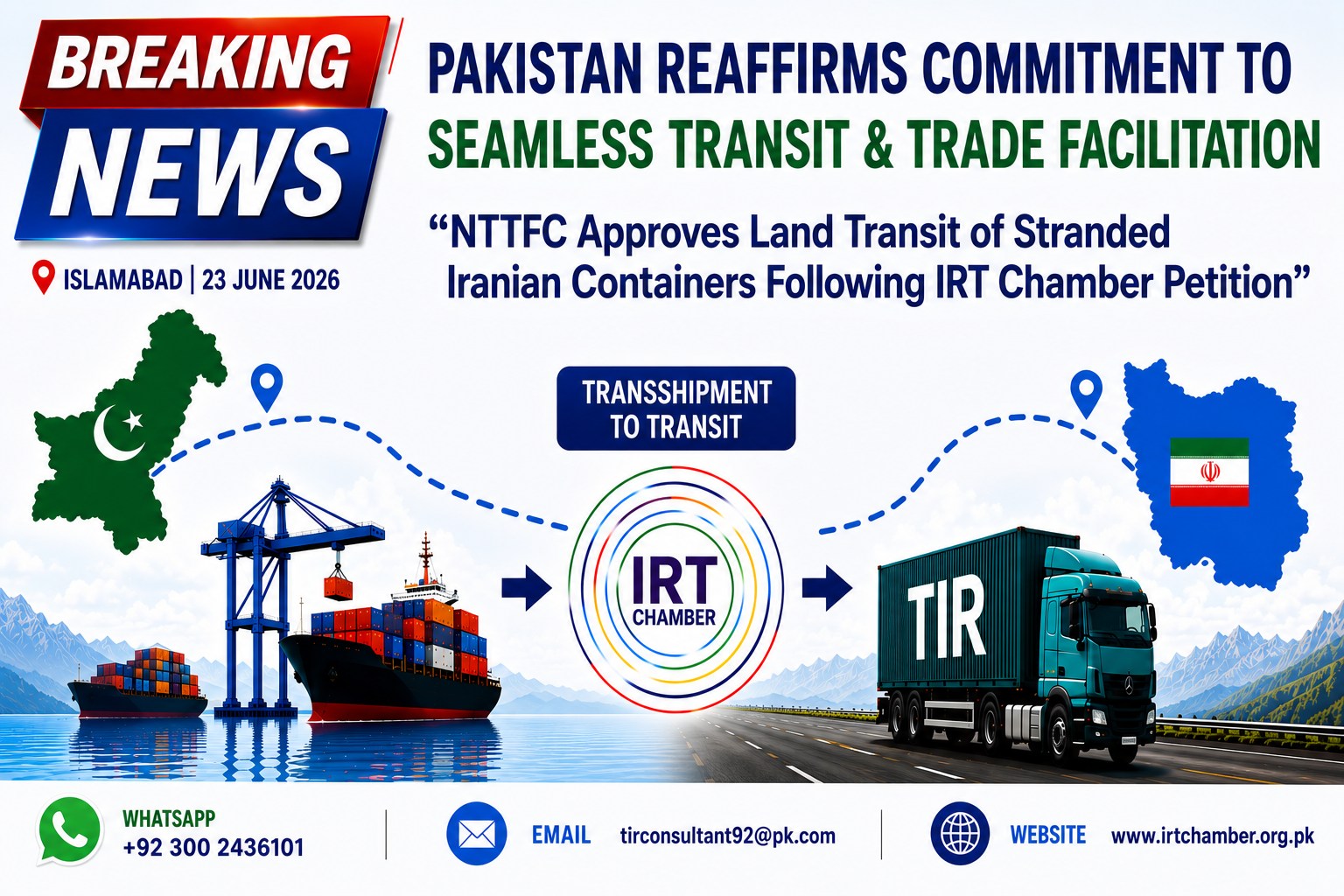
The International Road Transport Chamber of Pakistan (IRTCoP) welcomes the significant outcome of the 33rd Meeting of the National Trade and Transport Facilitation Committee (NTTFC), where an important decision was taken regarding the movement of Iran-bound stranded containers currently held at Pakistan's seaports.
This development follows the submission of a detailed petition by Mr. Rana Asif Khan, TIR Consultant, Customs Transit Regime Expert, and Founder President of IRT Chamber of Pakistan, vide Reference No. IRTCLLA/Iran Stranded Containers-01/2026 dated 12 June 2026, addressed to the Ministry of Commerce on behalf of affected consignees from Iran, Azerbaijan, Turkmenistan, and Uzbekistan.
The petition highlighted the extraordinary circumstances under which thousands of containers originally destined for Iran and neighboring regional markets were discharged at Karachi ports due to maritime disruptions, force majeure conditions, security concerns, and operational restrictions affecting shipping routes in the Persian Gulf region.
Acting under proper authorizations and powers of attorney from the affected consignees, Mr. Rana Asif Khan presented a comprehensive legal and policy framework supporting the onward movement of these stranded containers through Pakistan's land transit corridors under the TIR system. The petition argued that the cargo had never entered Pakistani commerce, remained under Customs control as international transshipment cargo, and therefore retained its foreign transit status.
Among the key arguments advanced were:
- The cargo was originally manifested as international transshipment cargo and remained under Pakistan Customs supervision.
- WeBOC processing and release status demonstrated that Customs had already accepted the cargo as bona fide international movement cargo.
- Conversion from sea transshipment to land transit under the TIR system would maintain Customs control while enabling delivery to the intended foreign destinations.
- The proposed movement would create no revenue risk for Pakistan because the goods were not intended for domestic consumption.
- International legal instruments, including the TIR Convention, WTO Freedom of Transit principles, Revised Kyoto Convention, ECO Transit Transport Framework Agreement, and bilateral Pakistan-Iran transport agreements, support facilitation of legitimate transit cargo.
- The movement would reduce port congestion, release valuable container equipment, prevent mounting demurrage and detention charges, and strengthen regional trade connectivity.
The petition further emphasized that affected consignments included industrial raw materials, consumer goods, and essential commercial cargo whose continued detention was causing substantial economic losses to importers and supply chains across the region.
During its 33rd meeting, the NTTFC considered the broader trade facilitation implications of the issue and approved the facilitation of land transit arrangements for the stranded Iran-bound containers. The decision reflects Pakistan's continued commitment to regional connectivity, trade facilitation, multimodal transport solutions, and the efficient implementation of international transit frameworks.
This landmark development demonstrates the importance of constructive engagement between government institutions, trade facilitation bodies, and the private sector in resolving complex logistics challenges affecting regional commerce.
IRT Chamber of Pakistan remains committed to supporting initiatives that promote seamless transit, efficient transport corridors, and enhanced regional trade cooperation under internationally recognized transit systems, including TIR.
Discussions (0)
No comments yet. Be the first to share your thoughts!